Choosing the right acupuncture school is one of the most important decisions you’ll make in your healthcare career. With multiple programs across Alberta, how do you determine which one will give you the best foundation for success?
CITCM’s acupuncture programs take a comprehensive approach, combining Western medical knowledge with Eastern healing wisdom to prepare graduates who can work confidently in both clinical rehabilitation and wellness settings.
Here’s a guide to help you make an informed decision about your acupuncture education.
What Makes a Quality Acupuncture Program?
Accreditation and Recognition
Before anything else, verify that your chosen program is recognized by major professional associations. CITCM’s acupuncture programs are approved by the College of Acupuncturists of Alberta (CAA), ensuring graduates can register as practicing acupuncturists upon completion.
The school is also licensed under the Private Vocational Schools Act and designated as a DLI (Designated Learning Institution), making students eligible for federal and provincial student loans and grants.
Additionally, since 2021, CITCM has been the first and only Canadian Branch College of Chengdu University of Traditional Chinese Medicine (CBC-CDUTCM) in North America, providing unique opportunities for international collaboration and bachelor’s degree pathways. You can learn more about our partnership here.
Program Pathways
CITCM offers four acupuncture program pathways:
- Doctor of Acupuncture Diploma
- Double Major Diploma – Doctor of Acupuncture & Doctor of TCM
- Double Major Plus – Acupuncture/DTCM plus 2200-Hour WE Integrated Orthopedic Massage
- Bachelor of Acupuncture & Moxibustion – earned through a partnership with Chengdu University of Traditional Chinese Medicine
All programs integrate Western medical knowledge with Eastern modalities, giving graduates a competitive advantage in the job market.
Clinical Training Component
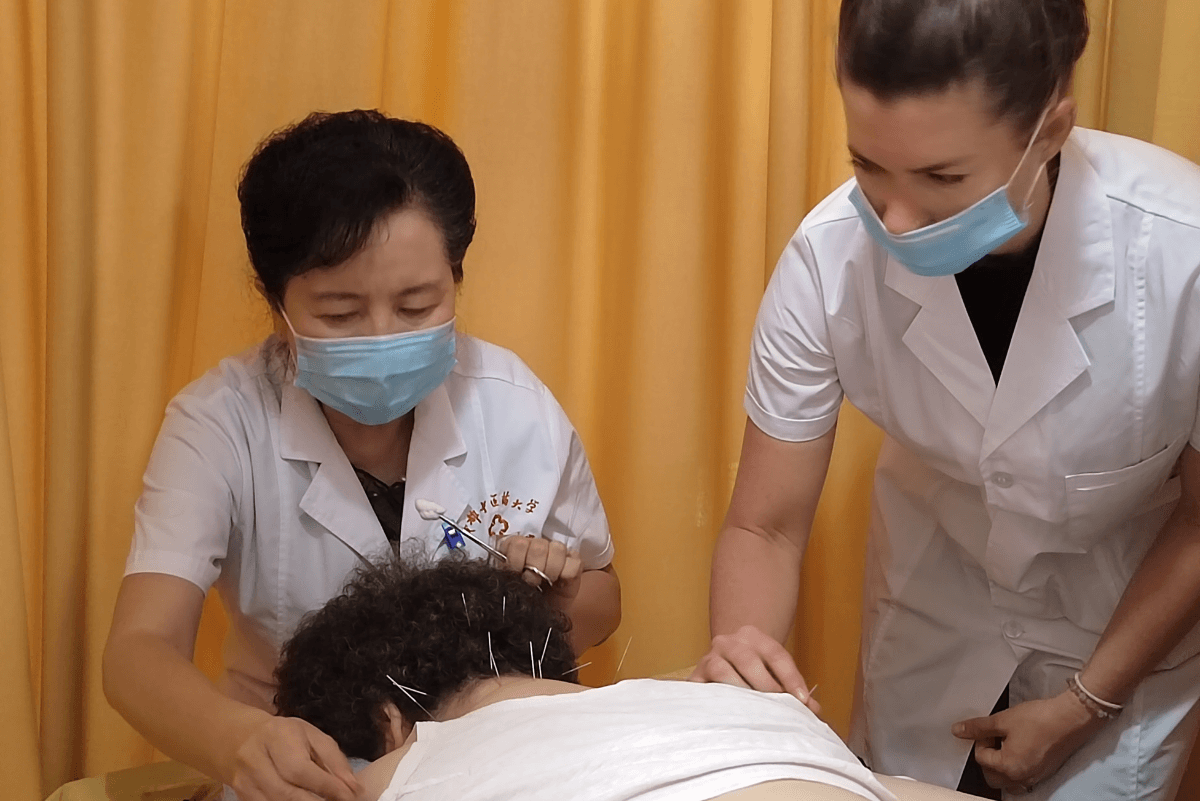
Students begin treating real patients under supervision starting in the second semester, with opportunities at both the onsite student clinic and community partner locations.
The CITCM Approach: Western & Eastern Integration
What Does “WE Integrated” Mean?
CITCM’s WE (Western & Eastern) Integrated Philosophy incorporates Western medical knowledge with Eastern healing wisdom. The curriculum emphasizes:
Western Components:
✓ Anatomy, physiology, and pathology
✓ Western physical assessment
✓ Orthopedic assessment protocols
✓ Biochemistry and microbiology
✓ Evidence-based practice
✓ Western Pharmacology
✓ Western Medicine
✓ Clinical Immunology
✓ Lab Test Reading
✓ Western Nutrition
Eastern Components:
✓ Acupuncture techniques and point location
✓ Traditional Chinese Medicine (TCM) theory and diagnostics
✓ Cupping and Gua Sha
✓ Moxibustion
✓ Medical Qi Gong and Tai Ji
✓ Chinese herbal medicine
✓ Tui Na massage
✓ Auricular Acupuncture
✓ TCM Diet Therapy
✓ Preventative Medicine
This integration gives CITCM graduates a diverse skill set that opens doors to multiple practice settings, from clinical rehabilitation to wellness environments.
Acupuncture Orthopaedic Sport Medicine Focus
Students in the Double Major program complete over 100 hours of orthopedic sports acupuncture training (Levels 1-3), learning to:
- Identify musculoskeletal dysfunction through systematic assessment
- Create evidence-based treatment plans
- Monitor and adjust treatment based on patient progress
- Communicate effectively with other healthcare providers
This prepares graduates to work confidently in multidisciplinary settings alongside physiotherapists, chiropractors, and physicians.
CITCM Curriculum: What You’ll Learn at Acupuncture School
CITCM’s acupuncture program builds your skills progressively, combining online theory courses with hands-on practical training.
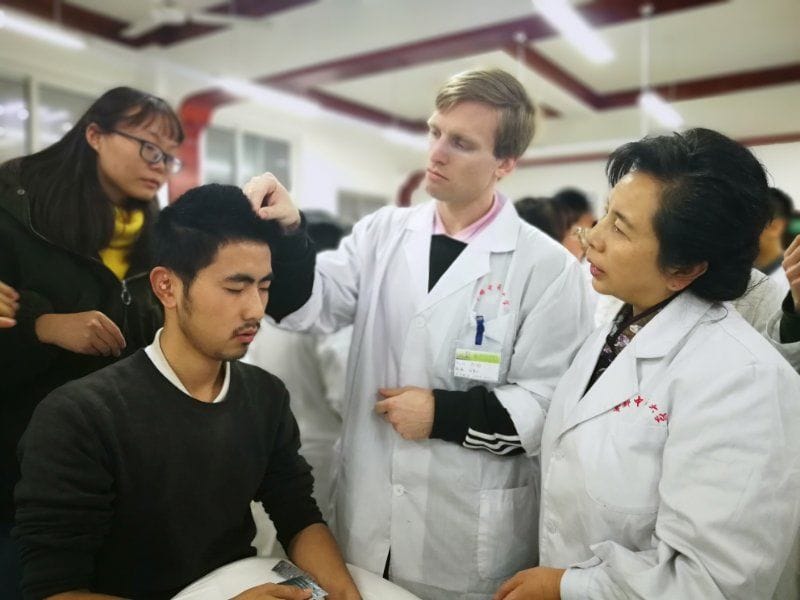
Acupuncture students observing patient assessment and treatment planning during hands-on training at CDUTCM
Core Knowledge Areas:
- Anatomy, physiology, and biomedicine
- TCM foundations and diagnostic techniques
- Acupuncture points and meridians
- Western pathology and assessment
- Chinese herbal medicine (double major)
- Business management and professional ethics
Hands-On Skills:
- Acupuncture needling techniques
- Orthopedic assessment and treatment
- Cupping, Gua Sha, moxibustion
- Auricular acupuncture
- Tui Na and specialized therapeutics
- Micro-acupuncture systems
- Herbal prescription
- Diet therapy consultation
- Acupressure
Clinical Training: The quality of acupuncture training in Calgary depends heavily on hands-on clinical experience. CITCM students gain practical experience at both the onsite student clinic and community partner locations, including Unison Alberta at Kerby Centre, The Alex Community Centre, Mustard Seed, and Shalem Society for Senior Citizens Care.
Students complete 4 clinical practicum hours per week in their first and second years, increasing to 8-10 hours per week in their third and fourth years.
Course Schedule & Format:
→ Classes: Monday-Friday, 8:00 AM to 12:00 PM
→ Clinical practicum: Onsite at CITCM clinic under supervision.
This format makes it realistic for career changers and working professionals to complete the program without significantly compromising income or family time.
Career Outcomes: Where Do Graduates Work?
Employment Rate
CITCM’s acupuncture programs boast a nearly 100% employment rate among graduates, a strong indicator of both program quality and industry demand.
Practice Settings
Graduates work across diverse environments:
Clinical Settings:
- Multidisciplinary clinics (alongside chiropractors, physiotherapists, naturopaths)
- Sports therapy centers
- Rehabilitation facilities
- Home-based clinical practices
- Mobile clinic services
Wellness Settings:
- Spa facilities
- Corporate wellness programs
- Athletic clubs and gyms
- Resorts and cruise ships
What Students Say About CITCM
When asked what they value most about the program, CITCM students consistently highlight:
✅ Diverse skill set that differentiates them from other acupuncture graduates
✅ Small practical class sizes allowing one-on-one instruction and personalized feedback
✅ Approachable instructors who are actively practicing in the field
✅ Positive learning environment that balances rigour with support
✅ Comprehensive clinic training with over 1,000 hours of onsite clinic observation and internship under acupuncture & TCM doctors
Additional Benefits of Attending CITCM’s Acupuncture Programs
Scholarship Opportunities
CITCM offers over $10,000 in annual bursaries and scholarships, including:
- Academic Excellence Award
- Clinical Excellence Award
- Bachelor’s Degree Bursary
- CDUTCM Bursary for bachelor’s degree internship
Continuing Education
After graduation, CITCM offers ongoing professional development through online and onsite workshops and seminars. The Continuing Education program provides opportunities to learn advanced techniques, expand your skill set, and connect with fellow practitioners.
Pathway to Additional Credentials
For graduates interested in expanding their practice scope, CITCM offers pathways to specialized certifications. The Double Major Acupuncture & TCM program combines Doctor of Acupuncture with Doctor of Traditional Chinese Medicine. The Double Major Plus program fast-tracks your education by combining acupuncture, Doctor of TCM, and WE Integrated Orthopedic Massage.
How to Evaluate Your Options
Questions to Ask Any Acupuncture School in Alberta
- What is the program’s total hour count, and how does it break down between theory, practical skills, and clinical training?
- What percentage of graduates are employed within 6 months of completion?
- What is the student-to-instructor ratio in practical classes?
- When do students begin treating real patients under supervision?
- What Eastern modalities are included in the curriculum, if any?
- Are students eligible for government student loans?
- What is the class schedule, and is it compatible with working part-time?
- What additional certifications or specializations can I pursue after graduation?
- Can I visit the school, observe a class, and tour the clinical facilities?
- Does the school have an offsite work practicum program?
Red Flags to Watch For
🚩 Lack of diverse and experienced instructors and clinic supervisors
🚩 Lack of clinic experience due to low clinic traffic
🚩 No clear pathway to professional registration after graduation
🚩 Lack of administrative/student support staff
🚩 School or program not listed/approved by the governing body in the province (in Alberta, check with the College of Acupuncturists of Alberta.)
Making Your Decision
Choosing an acupuncture school isn’t just about location or cost; it’s about finding a program that will prepare you for the career you envision. Consider:
If you want maximum career flexibility: The Double Major program qualifies you to practice as both a Doctor of Acupuncture and Doctor of TCM, meeting requirements for registration in multiple provinces including BC and Ontario.
If you’re interested in international opportunities: CITCM’s partnership with Chengdu University of Traditional Chinese Medicine offers pathways to a globally recognized bachelor’s degree and eligibility for TCM Practitioner licensure around the world.
If you value integrated medicine: Look for programs that teach both Western and Eastern modalities, preparing you to work confidently alongside other healthcare professionals.
Explore whether CITCM is the right fit for your acupuncture education. Book an info session and campus tour to experience the learning environment firsthand, meet current students and instructors, and get your specific questions answered.