Rarely do patients arrive at an acupuncture appointment with concerns that fit neatly into one category. Someone seeking treatment for chronic pain might also mention irritability or a loss of motivation, while another could describe persistent fatigue alongside changes in mood and difficulty concentrating.
These overlapping presentations reflect a wider trend. The World Health Organization reported a 25% rise in global anxiety and depression in the first year of the COVID-19 pandemic alone, and by 2025 estimated that more than one billion people were living with a mental health condition, now the second leading cause of long-term disability worldwide.
For practitioners of traditional Chinese medicine (TCM), the link between emotional and physical health is familiar ground. Understanding how physical symptoms and emotional experiences relate to one another has long been part of TCM theory and practice.
The Ben Shen Clinical System offers a framework for examining those relationships more systematically. Drawing on classical Chinese medicine concepts, it provides practitioners with an effective approach to psycho-emotional observation, pattern differentiation, and individualized care.
What Is Ben Shen?
Ben Shen (本神) is often translated as “Rooted Spirit” or “rooting in the spirit.” The term comes from classical Chinese medicine. It is the title of Chapter 8 of the Lingshu (Spiritual Pivot), one of the two texts that make up the Huangdi Neijing (Yellow Emperor’s Inner Classic). The chapter explores relationships between mental activity, emotional experiences, and physiological functioning, and it opens by stating that all needling must first be rooted in Shen.
Within TCM, Shen is often associated with consciousness, mental activity, and emotional well-being. Ben refers to a root or foundation. Together, the term reflects the classical view that Shen is fundamental to health, and that mental and emotional health cannot be considered entirely separately from the body’s functioning.
These classical ideas provide the foundation for the Ben Shen Clinical System, a contemporary clinical framework developed by Professor Changqing Joseph Yang, PhD, L.Ac.
Professor Yang, who trained in Chinese medicine at Heilongjiang University of Chinese Medicine and in psychiatry at Aichi Medical University and Kobe University in Japan, developed and refined the system over more than four decades of clinical, academic, and research work, with a long-standing focus on integrative mental health care. His approach organizes established TCM concepts into a structured method for understanding psycho-emotional presentations, while incorporating contemporary clinical knowledge and an emphasis on responsible patient care.
The Concepts Behind the Framework
The Ben Shen Clinical System draws on several interconnected concepts that practitioners will likely recognize from their foundational TCM education. These are all theoretical concepts within Chinese medicine, rather than direct equivalents of modern psychiatric diagnoses or neurobiological structures.
The Ben Shen Clinical System adds a way to bring them together, along with additional approaches to observation and pattern differentiation, so practitioners can organize information about complex psycho-emotional presentations.
Jing, Qi, and Shen
These three fundamental concepts are used to describe different aspects of human vitality and functioning. Jing is traditionally associated with essence and constitutional foundations, Qi with functional activity and movement, and Shen with consciousness and mental-emotional expression. The relationship among these concepts provides one way to consider how physical health, daily functioning, and emotional experiences may influence one another within TCM theory.
The Five Zhi
The Five Zhi refer to five emotional categories traditionally associated with the Zang organs: anger (Liver), joy (Heart), pensiveness or overthinking (Spleen), grief or sadness (Lung), and fear (Kidney). These associations help practitioners consider emotional experiences within a broader pattern of signs and symptoms.
The Five Shen
These are five aspects of mental and spiritual functioning: Shen, Hun, Po, Yi, and Zhi. Each is traditionally associated with a particular Zang organ (Shen with the Heart, Hun with the Liver, Po with the Lung, Yi with the Spleen, and Zhi with the Kidney) and contributes to the classical understanding of human mental activity.
From Observation to Clinical Reasoning
Psycho-emotional observation begins with understanding how patients describe their experiences and recognizing changes that may provide insight into their overall health.
During a consultation, a practitioner may ask about sleep, appetite, energy levels, concentration, emotional well-being, and daily routines. They may also pay attention to the patient’s speech, demeanour, and other aspects of their presentation.
Within the Ben Shen Clinical System, these observations help guide clinical reasoning by providing context for assessing Yin-Yang (Dian-Kuang), Shen-Qi, and Five Shen patterns. However, no single symptom or observation is enough to establish a particular TCM pattern.
For example, a patient who reports frequent irritability may also be dealing with physical discomfort, pressure at home or work, or changes in their daily environment. Rather than immediately associating that irritability with a specific pattern, the practitioner considers these factors together, asks follow-up questions, and looks for relationships among the findings.
This more comprehensive approach helps practitioners make informed decisions about pattern differentiation and individualized care planning. It also supports more thoughtful patient communication, allowing practitioners to discuss their observations without making assumptions about a patient’s mental health.
Studying the Ben Shen Clinical System
CITCM’s Advanced Certification in Integrative Mental Health Care with Chinese Medicine teaches the full Ben Shen framework, with Professor Yang as lead instructor. Now accepting applications for the January 2027 cohort.
Ben Shen in Practice: A Step-by-Step Example
A patient experiencing difficulty sleeping may also be dealing with increasing workplace stress, changes in mood, and disruptions to their daily routine. During an initial consultation, the practitioner might learn that the patient frequently wakes during the night, skips meals, and struggles to maintain their usual activities.
Using the Ben Shen framework, the practitioner would look beyond the individual complaints of stress and poor sleep to understand how these symptoms relate to the patient’s overall health.
1. Build the Clinical Picture
The practitioner explores:
- When the sleep disturbance and emotional changes began
- Changes in appetite, energy, activity, and daily routine
- Current stressors and possible triggers
- Physical health history and medications
- How the symptoms are affecting work, relationships, and daily functioning
2. Apply Ben Shen Theory
The practitioner incorporates their understanding of Ben Shen theory to assess how Shen, Qi, emotional patterns, constitution, and lifestyle may be contributing to the presentation. Knowledge from the program’s Ben Shen Preservation module may help the practitioner consider:
- Shen-Qi patterns
- Five Zhi emotional disharmony
- Yin-Yang personality and constitutional tendencies
- Lifestyle influences and stress triggers
- Seasonal and environmental factors
- Sleep, nutrition, activity, and self-regulation
3. Communicate & Engage the Patient
Using skills developed in the program’s Ben Shen Integrative Communication Mental Care module, the practitioner creates a supportive environment for the patient to discuss sensitive concerns. This may include:
- Therapeutic presence and self-Shen management
- Open-ended and supportive interviewing
- Trust building and patient engagement
- Ben Shen communication approaches such as warning, talking, leading, and opening
- Recognition of difficult or trauma-related presentations
- Professional boundaries, risk recognition, and appropriate referral
4. Develop an Individualized Treatment Plan
The practitioner integrates the clinical findings and Ben Shen assessment into an individualized care strategy. Depending on the practitioner’s scope of practice and the patient’s presentation, this may include:
- Acupuncture. Selecting acupuncture points and treatment strategies based on TCM pattern differentiation and relevant Ben Shen patterns.
- Chinese Herbal Medicine. Developing an individualized herbal prescription when appropriate, while considering the patient’s constitution, symptoms, current medications, safety, and potential herb-drug interactions.
- Lifestyle & Ben Shen Preservation Strategies. Supporting the patient with appropriate recommendations related to sleep, daily routines, emotional regulation, seasonal living, stress management, nutrition, and self-regulation exercises.
5. Reassess & Adjust
At follow-up visits, the practitioner reviews changes in:
- Sleep
- Mood
- Stress
- Energy
- Daily function
- Physical symptoms
- Overall well-being
The acupuncture treatment, herbal prescription, communication approach, and lifestyle recommendations can then be adjusted according to the patient’s response and evolving clinical picture. Practitioners learn to integrate Ben Shen theory and assessment into a structured, patient-centred approach to mental-emotional care.
How Ben Shen Supports Clinical Treatment Protocols
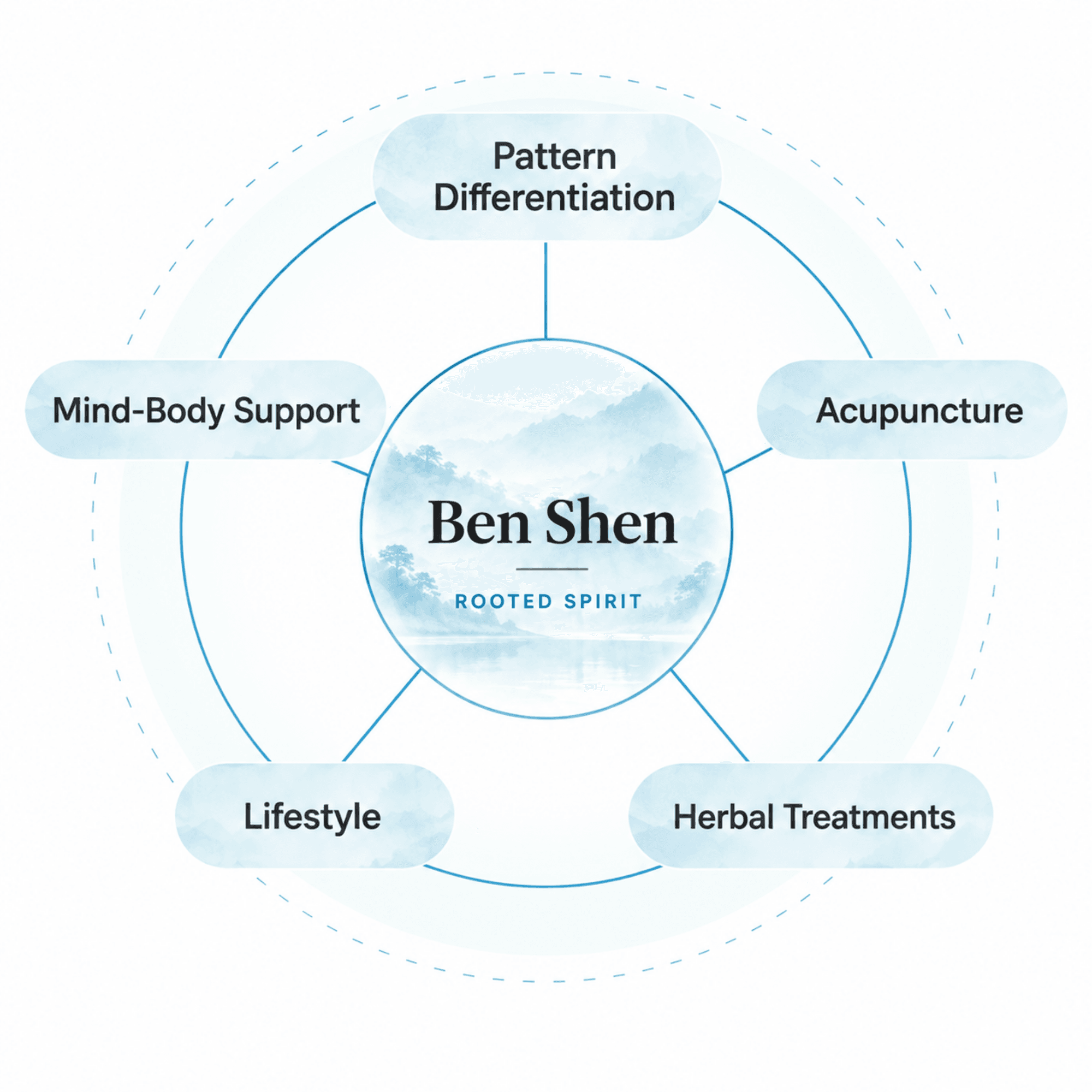
The Ben Shen Clinical System provides a framework for translating clinical observations and TCM pattern differentiation into individualized patient care.
Rather than relying on a single treatment method, practitioners can draw on four complementary approaches depending on the patient’s needs, clinical presentation, and treatment goals:
- Acupuncture: TCM pattern differentiation helps guide treatment planning, including the selection of appropriate acupuncture techniques and treatment principles within the practitioner’s professional scope.
- Chinese herbal medicine: Qualified practitioners may incorporate herbal medicine into a broader care plan where it falls within their legal and professional scope, taking into account potential contraindications, medication interactions, and other safety considerations.
- Wellness preservation and self-regulation: Lifestyle adjustments, breathing exercises, movement, and other self-regulation practices may help patients establish healthier routines and support their overall well-being.
- Therapeutic communication and supportive care: These approaches integrate Five Zhi relationships, Yin-Yang personality tendencies, Dian-Kuang communication methods, and Shen-Qi patterns to support more individualized and effective patient communication.
Not every patient will benefit from the same combination of approaches. Practitioners must consider the individual’s symptoms, preferences, and overall health alongside available evidence and their own professional scope and qualifications when developing a care plan.
Supporting Care Within Scope
The Ben Shen Clinical System helps practitioners deepen their understanding of psycho-emotional concerns through a Traditional Chinese Medicine framework and apply this knowledge more thoughtfully in clinical practice. It is intended to complement—not replace—psychiatric assessment, established diagnostic procedures, or provide effective and evidence-based mental health treatment protocols.
Studying Ben Shen at CITCM
Understanding the concepts behind Ben Shen is one thing; applying them confidently and appropriately in clinical practice requires deeper training, structured guidance, and experience.
CITCM’s Advanced Certification in Integrative Mental Health Care with Chinese Medicine teaches Professor Changqing Joseph Yang’s Ben Shen Clinical System in depth, with Professor Yang as lead instructor. The program combines traditional TCM theory with evidence-informed principles, clinical case studies, communication strategies, and safety and referral considerations, so you leave with a framework you can apply across a wide range of patient presentations.
The program is designed for registered acupuncturists, TCM practitioners, healthcare professionals authorized to practise acupuncture, and eligible senior students. This one-year certification combines primarily online learning through live lectures with 10 hours of onsite practical training.
Now accepting applications for the January 2027 cohort. Learn more about the Advanced Certification in Integrative Mental Health Care with Chinese Medicine, including the curriculum, eligibility requirements and how to apply.
Join a Free Online Info Session
Learn more about the program from Professor Changqing Joseph Yang, including Ben Shen theory, the program modules, delivery format, and costs, with time for Q&A.Thursday, November 5 or Thursday, November 26
6:30–7:30 PM MST, online via ZoomTo register, contact admission@citcm.com or call (403) 520-5258.
Related Articles

Acupuncture, Herbal Therapy, Traditional Chinese Medicine

Herbal Therapy, Traditional Chinese Medicine