Changing careers is not a decision most people take lightly. You need solid information in front of you, including time commitments, cost, and daily realities, before you make yours. If you want to become a massage therapist, you likely have specific questions about what training involves and what the profession’s outlook is like.
Here are clear answers to the most common questions.
How Much Do Massage Therapists Make?
Compensation for a massage therapist varies based on your work environment and experience level. According to Indeed, the average massage therapist in Alberta earns $57.48 per hour. Your annual income will depend on your work environment — whether you’re in a multidisciplinary clinic, running a private practice, or taking shifts at a spa.
Many practitioners build their income gradually as they establish a reliable client base. Clinic owners often pay therapists a percentage of each treatment fee. Independent practitioners keep the full fee but must cover their own overhead costs. Building a full-time schedule requires a significant time investment during your first year of practice.
How Long Does It Take to Become a Massage Therapist?
In addition to the time required to build your practice and client list, completing your education takes time.
In Alberta, most recognized massage therapy programs take 18 to 24 months to complete. The province also requires 2200 hours of formal training to qualify for registration with a professional association such as the National Health Practitioners of Canada (NHPC) or the Canadian Massage and Manual Osteopathic Therapists Association (CMMOTA).
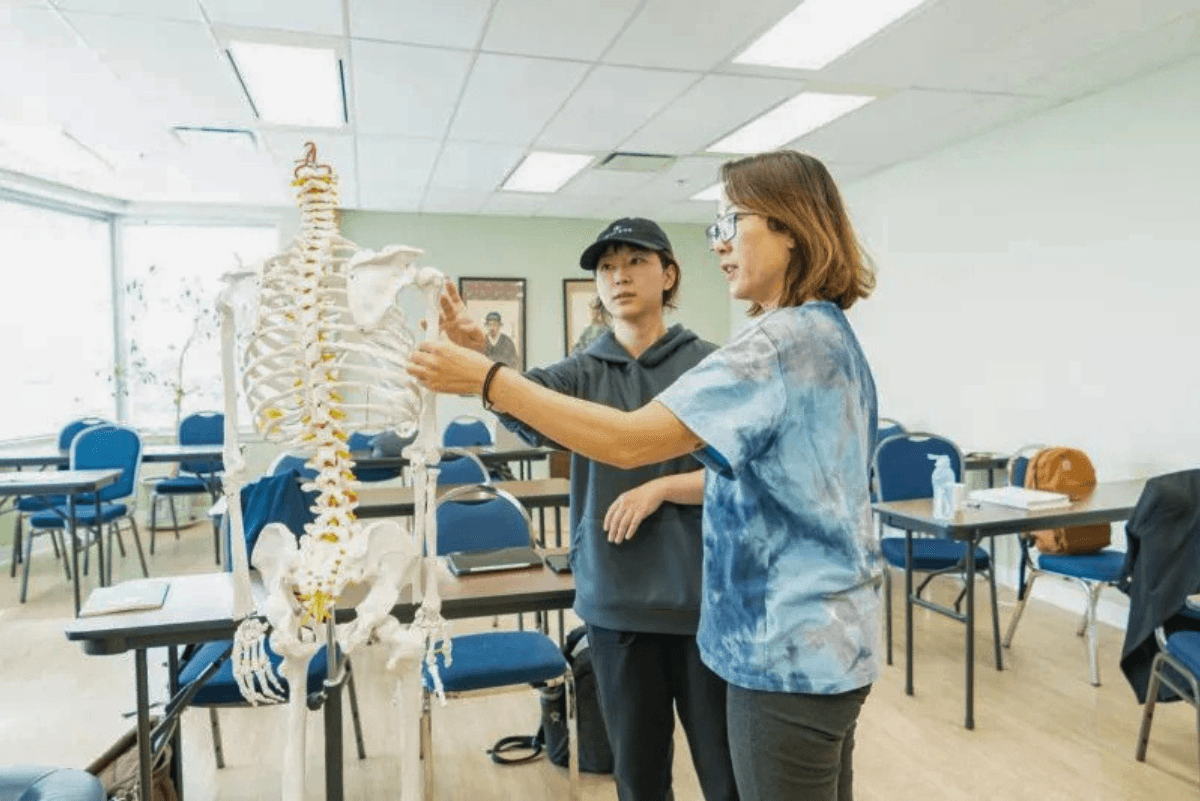
During these months, you’ll spend time in traditional classroom settings learning anatomy and physiology. You’ll also complete hundreds of hours of hands-on clinical practice. This structure provides the theoretical knowledge and practical skills you need to treat patients safely.
Can You Complete Your Massage Therapy Training Online?
Massage therapy is an inherently physical practice, making it impossible to learn the necessary palpation skills, pressure techniques, and patient positioning through a computer screen. This is why most recognized programs require in-person attendance for all practical components.
Some schools offer hybrid models in which you study theoretical subjects online before completing the core of your education in a classroom and student clinic.
Instructors need to observe your body mechanics and correct your hand placement in real time — something only in-person training can provide.
How Much Does Massage Therapy School Cost?
The earning potential of a massage therapy career makes the cost of massage therapy education worthwhile for many students. But it’s still an investment to plan for.
Tuition for a 2200-hour diploma in Alberta generally ranges from $18,000 to $25,000. At CITCM, tuition for the 2026/2027 academic year is under $13,000, making it one of the more affordable options in Calgary. Outside of that base tuition, you also want to budget for additional expenses like textbooks and professional uniforms.
Most accredited programs also qualify for provincial and federal student loans to help you manage these costs. Learn more about CITCM’s tuition and available funding options.
Can You Work While Studying Massage Therapy?
Many CITCM students maintain both full-time and part-time employment during their studies, since classes and clinical practicum only require three days per week. This schedule gives you the flexibility to work around your courses without having to choose between your education and your income.
If you plan to work while attending massage therapy school, look for flexible jobs that allow you to adjust your hours around your courses and exam periods.
What Qualifications Do You Need to Become a Massage Therapist in Alberta?
Alberta doesn’t currently regulate massage therapy under the Health Professions Act. However, the industry self-regulates through professional associations like NHPC and CMMOTA. To work legally and allow your clients to claim treatments on their health insurance, you need to join one of these associations.
The standard requirement for association membership is a diploma from a 2200-hour curriculum. The school must be approved by Alberta Advanced Education.
Once you graduate, you submit your transcripts to an association, pass their specific entry requirements, and purchase professional liability insurance. Only then can you issue valid insurance receipts to your patients.
Is It Hard to Become a Massage Therapist?
Massage therapy school is rigorous, but most students find it deeply rewarding. The program challenges you both mentally and physically, and that’s by design. You’re training to work with real patients, so the standards are high.
On the academic side, you’ll build a thorough understanding of the human body, learning how muscles, nerves, and systems work together and how to assess and support your clients’ health. Many students are surprised by how much they enjoy this part. The knowledge translates directly into better hands-on results, and watching clients improve because of your skills is one of the most motivating parts of the journey.
The hands-on training is equally engaging. Your instructors will teach you how to generate pressure from your core, protect your own body while you work, and develop the kind of tactile precision that sets a skilled therapist apart. You’ll build these skills alongside your classmates in a supportive environment.
For many people, the reason they enroll is simple: they want to help others feel better. Massage therapy school gives you the tools to do exactly that.
What Is the Job Outlook for Registered Massage Therapists?
The demand for skilled massage therapists is consistently strong across the province. Healthcare providers increasingly recognize massage therapy as a valuable tool for pain management, injury recovery, and stress reduction.
You’ll find job opportunities in chiropractic offices, physiotherapy centres, sports medicine facilities, and spas.
How to Choose a Reputable Massage Therapy School
Start by confirming the school teaches a recognized 2200-hour program. Then, ask about the instructors’ credentials and clinical experience. You want to learn from professionals who actively treat patients.
If possible, visit the campus to view the student clinic and classroom facilities. Pay special attention to the class sizes, as smaller groups mean you’ll get more direct feedback on your techniques. Ask the admissions team about their graduate success rates and where their alumni currently work.
Some schools also integrate Eastern healing modalities, such as cupping and gua sha, alongside Western orthopedic training, which can broaden your career options significantly. Ask whether the program covers both.
A reputable school will welcome your questions and provide clear, direct answers.
Exploring your massage school options?
Learn more about CITCM’s WE Integrated Orthopedic Massage Program.
Taking the Next Steps with CITCM
You now have a clearer picture of what the training involves, what it costs, and what a career in massage therapy looks like in Alberta. The next step is to gather specific program information and find out how CITCM’s massage program differs from other schools.
Reach out to the admissions team at CITCM to learn more about the curriculum, upcoming intake dates, and campus life. Our team is happy to answer any questions you have.
Related Articles
CITCM Massage Therapy Training